How I carved out 3 hours every Friday morning to stay ahead of AI trends (and why you should too)
Learn how I blocked out 3 hours every Friday morning to master AI tools and trends. A practical, repeatable system with the exact newsletters, YouTube channels, podcasts, and hands-on testing approach that keeps busy entrepreneurs ahead of the AI curve without getting overwhelmed.
Dom O'Brien
1/20/202610 min read

Look, I'll be honest with you. About six months ago, I was drowning in AI news. Every time I opened LinkedIn or Twitter, there was another tool launch, another research paper, another "game-changing" announcement. I'd save articles to read later, bookmark YouTube videos, and subscribe to newsletters that piled up unread in my inbox.
Sound familiar?
The breaking point came when I was in a meeting and someone mentioned a tool that had apparently been making waves for weeks. I had no idea what they were talking about. That's when I realised that trying to keep up with AI "whenever I had time" wasn't working. I needed a better system.
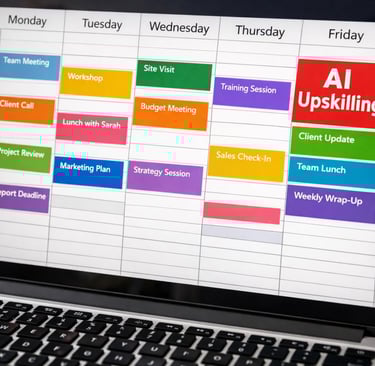
So I did something that felt a bit extreme at first. I blocked out every Friday morning from 8am to 11am. Three full hours. No meetings, no emails, no Slack. Just me and whatever was happening in the AI world and I protect it like nothing else!
Six months in, it's genuinely changed how I work and how I think about my business - and I think the system can be copied for almost any area you want to improve your knowledge. Here's exactly what I do during those three hours, and more importantly, why it actually works.
Why Friday morning specifically?
Before I break down the routine, let me explain the timing. Friday mornings are strategic for a few reasons.
First, you've got the entire week's worth of announcements to review. AI companies love dropping news on Tuesdays and Wednesdays, so by Friday you're seeing the full picture and the initial reactions from people who've actually tried things.
Second, Friday afternoons are typically slower in most businesses. If I discover something worth testing or implementing, I can spend Friday afternoon playing with it before the weekend. Or I can let it simmer over the weekend and come back Monday ready to experiment.
Third, and this might sound silly, but Friday mornings feel optimistic. You're not in the Monday grind or the Wednesday slump. There's a lightness to Friday that makes exploring new ideas feel exciting rather than like homework.
Hour one: The newsletter deep dive (8am to 9am)
I start with newsletters because they're curated. Someone else has already done the work of filtering signal from noise.
I subscribe to five newsletters that I actually read every week. Not twenty. Not fifty. Five.
Here's my current lineup:
The Rundown AI - This is my "what happened this week" catch-up. It's quick, it's comprehensive, and it helps me spot the stories everyone's talking about. Over 1.75 million people read this for a reason.
Superhuman AI - Zain Kahn's newsletter is brilliant for practical applications. I don't care about every research paper coming out of Stanford. I care about tools I can actually use on Monday. That's what Superhuman delivers.
The Neuron - This one bridges the gap between "what's new" and "why does it matter for my business." The framing is always strategic rather than just informational.
Ben's Bites - Ben keeps it real. His newsletter has personality and covers the weird, interesting stuff happening in AI, not just the big corporate announcements.
TLDR AI - Super efficient daily summaries that I can scan in minutes if I'm short on time during the week. But Friday mornings I go back and read the ones I skipped.
One final thing I have set up is a GrokAI email that is focused on surfacing any AI information that is relevant to marketing use cases, tools or developments, just in case I have missed it.
My process is simple. I have a folder in my email called "Friday AI" and throughout the week, these newsletters automatically filter there. Friday morning, I sit down with coffee and actually read them. Not skim. Read.
I keep a running Google Doc open where I note anything interesting in three categories: "Try This Week," "Watch This," and "Think About This." That's it. No complex system. Just three buckets.
The key is I'm not trying to understand everything deeply in this hour. I'm scanning for signals. What's getting repeated across multiple sources? What are smart people excited or worried about? What tools keep coming up?
Hour two: YouTube deep dives and tutorials (9am to 10am)
Hour two is where I go deeper on specific topics or tools that caught my attention in the newsletters.
I've got a tight list of YouTube channels I trust, and I subscribe to them all so new videos hit my feed. Here are the ones I check every Friday:
Matt Wolfe - Matt reviews AI tools and provides no-code tutorials that actually work. If you're not a developer (I'm not), his channel is gold. He tests stuff so you don't have to.
AI Explained - When I need to understand what a research breakthrough actually means, this is where I go. Technical enough to be accurate, accessible enough that I can follow along.
All About AI - Great for staying current on ChatGPT, Claude, and the major AI assistants. Since I use these tools daily, knowing their new features matters.
Two Minute Papers - Research papers explained visually in under 5 minutes. Perfect for understanding what's coming down the pipeline without reading 40-page PDFs.
Wes Roth - Wes covers AI news with good analysis of what developments mean for the industry. He's thoughtful about implications, not just hype.
During this hour, I'm not watching everything. I'm strategic. If something in the newsletters mentioned a new capability or tool, I search for it on YouTube. Seeing someone actually use a tool beats reading about it every time.
I usually watch at 1.5x speed and take quick notes in the same Google Doc from hour one. If a tutorial looks like something I want to try, it goes in the "Try This Week" section with a link to the video.
The goal isn't to become an expert in everything. It's to build enough familiarity that when these topics come up in conversations, meetings, or client work, I'm not completely lost.
Hour three: Hands-on testing and experimentation (10am to 11am)
This is where everything comes together. Hour three is for actually doing something with what I've learned.
Some Fridays, this means signing up for a new tool and running it through its paces. Other weeks, it means taking an existing tool I use and trying a new feature or approach I learned about.
Recent examples:
A few weeks ago, I spent this hour testing Perplexity's new research features after seeing it mentioned in three different newsletters. I ran the same research query I'd normally do manually and compared results. Turns out it saved me about 45 minutes on competitive research. That went straight into my regular workflow.
Another Friday, I experimented with Claude's new project features after watching a tutorial. Set up a project for content creation with custom instructions, sample outputs, and reference documents. Now when I need to write similar content, I just use that project instead of starting from scratch every time.
Last month, I used this hour to test AI image generation for blog headers after The Rundown mentioned some new features. Spent the hour generating 20+ variations of different styles. Now I have a process that takes 10 minutes instead of hunting for stock photos for an hour.
The point is, this isn't passive learning. I'm building actual skills and discovering actual efficiencies I can use in my business.
If there's nothing new I'm excited to test, I use this hour differently. Sometimes I'll:
Revisit a tool I tried months ago to see if it's gotten better
Clean up my AI tool stack and unsubscribe from things I'm not using
Document processes I've developed so my team can use them
Browse Product Hunt or There's An AI For That to discover new tools
The key is the time is protected. It doesn't get stolen by "urgent" things unless something is actually on fire.
The podcasts I listen to (bonus content for commutes)
I mentioned this is a three-hour block, but I'd be lying if I said I only consume AI content on Fridays. Throughout the week, I'm listening to podcasts during commutes, at the gym, or while doing household stuff.
Here are the podcasts that regularly make it into my rotation:
The AI in Business Podcast - Daniel Faggella interviews executives from Fortune 500 companies about real AI implementations. Not theory. Not hype. Actual ROI and lessons learned.
Practical AI - Hosted by developers who actually build AI systems. Technical but not over my head, and they focus on what works in production.
The Cognitive Revolution - Nathan Labenz asks the hard questions about where AI is heading. Good for thinking beyond just the tools.
AI Hustle - Perfect for entrepreneurs. They cover AI news but also interview people building businesses with AI. The side hustle angle is relatable.
Everyday AI - Does what it says on the tin. Practical AI advice for everyday business use, no PhD required.
Marketing Against the Grain - Brought to you by Hubspot, the guys lead you down the rabbit hole of marketing trends, growth tactics and innovation and have some great video walkthroughs to match
I don't listen to all of these every week. I pick episodes based on topics relevant to what I'm working on. But having them in my podcast app means I'm always learning something during otherwise dead time.
What I've learned works (and what doesn't)
After six months of this routine, here's what I've figured out.
What works:
The consistency matters more than the time. Three hours every Friday is way more effective than seven random hours scattered across a month. Your brain starts to expect it and process things differently.
Taking notes in a simple system beats trying to remember everything. My three-bucket Google Doc (Try This Week, Watch This, Think About This) is stupid simple, but it works because I actually use it.
Hands-on testing is non-negotiable. Reading about tools doesn't teach you anything. Using them does. Even if you only spend 30 minutes with something, you'll understand it better than reading ten articles.
Focusing on business application over cool factor. There are a million impressive AI demos that won't help you do your job better. The question I ask is always "Would this save me time, make me money, or improve my work quality?"
What doesn't work:
Trying to understand everything deeply. You can't. The field moves too fast. Being broadly familiar with a lot is more valuable than being an expert in one thing that might be obsolete in three months.
Subscribing to too many newsletters. I started with twenty. I read none of them. Five newsletters that I actually read beats twenty that sit unread.
Perfectionism about the routine. Some Fridays I only get two hours. Some weeks I skip entirely because I'm traveling or genuinely slammed. That's fine. The point is consistency over time, not perfect attendance.
Getting caught up in AI Twitter drama. There's always someone saying the world is ending or GPT-17 will cure cancer. I ignore most of it. I focus on practical tools and trends with actual business implications.
How you can start your own AI discovery routine
You don't need to copy my Friday morning approach exactly. Maybe you're better with Tuesday afternoons or Sunday mornings. Maybe you can only carve out 90 minutes instead of three hours. That's completely fine.
Here's how to build your own version:
Step 1: Pick your time and protect it
Look at your calendar and find a recurring block that could work. It should be:
At least 90 minutes (less than that and you're just scratching the surface)
At a time when your brain is fresh (not Friday at 4pm when you're toast)
Consistent (same time each week builds the habit)
Put it in your calendar as a recurring event. Make it a "busy" block so people can't book over it. Give it a name like "AI Research" or "Learning Time" or whatever makes you take it seriously.
Step 2: Choose 3 to 5 newsletters max
Start with The Rundown AI and Superhuman AI since they're beginner-friendly and comprehensive. Add 2-3 more based on your specific interests (business, technical, creative, whatever).
Set up a folder in your email and filter them there automatically. Resist the urge to subscribe to fifteen more. You can always swap one out later if it's not serving you.
Step 3: Find 3 to 5 YouTube channels
Matt Wolfe is a great starting point for non-technical folks. Two Minute Papers is great for everyone. Add channels based on your needs.
Subscribe and turn on notifications for new uploads. That way you're not hunting for content every week.
Step 4: Create a simple note-taking system
Google Doc, Notion, whatever. Just make it simple enough that you'll actually use it. My three buckets (Try This Week, Watch This, Think About This) work for me. You might want different categories.
The point is capturing what's interesting so you can act on it later. Without notes, everything blurs together.
Step 5: Commit to testing something every session
This is the hardest part but also the most important. You have to actually use tools, not just read about them. Even if it's just 20 minutes of playing around, do something hands-on every session.
Sign up for free trials. Run experiments. Break things. That's where the real learning happens.
Step 6: Review and adjust monthly
After a month, look at what's working. Are you actually reading all those newsletters? Are you finding value in those YouTube channels? Is the time block working for your schedule?
Adjust whatever isn't working. This should make your life better, not feel like homework.
The real benefit isn't just knowing about AI
Here's what surprised me most about this routine. It's not just that I know more about AI tools and trends (though I do). It's that I've become better at spotting opportunities and solving problems creatively.
When someone in a meeting mentions a business challenge, I can often think of an AI approach that might help. Not because I'm smarter, but because I've been consistently exposing myself to what's possible.
When I'm facing a tedious task, I automatically ask "Is there an AI tool that could do this?" And increasingly, the answer is yes, because I've built enough familiarity with the landscape to know what to look for.
When clients ask about AI, I can have informed conversations instead of vague hand-waving. That's built trust and opened doors to new projects.
The compound effect is real. After six months, I'm not just incrementally better at AI. I'm seeing patterns and connections I wouldn't have spotted otherwise. I'm making decisions faster because I have a clearer sense of what works and what's hype.
And honestly? It's fun. That Friday morning block is one of my favorite parts of the week now. There's something energising about carving out time to learn and explore without immediate pressure to monetise or optimise or produce.
Start small, but start
If you take one thing from this post, make it this: you don't have to quit your job to stay current with AI. You don't need a computer science degree or a massive budget for courses.
You just need a system and consistency.
Three hours on Friday mornings works for me. Maybe it's two hours on Sunday mornings for you. Maybe it's four 30-minute sessions spread through the week. The structure matters less than the habit.
But here's my challenge to you: block out time right now. Open your calendar and find a recurring slot in the next two weeks. Just try it once and see what happens.
The worst case? You spend a few hours learning about tools and trends that might not immediately help. The best case? You discover something that changes how you work, opens up new opportunities, or just makes your day-to-day easier.
The AI revolution isn't coming. It's here. And the difference between people who thrive and people who get left behind won't be raw intelligence or coding skills. It'll be who stayed curious and who didn't.
So yeah, carve out those three hours. Your future self will thank you.
Contact Us
© 2025. All rights reserved.