
The Positioning Treadmill: How to Market a Product That Won't Stop Moving
Your product team ships fast. Great for them. Chaos for you. If you're constantly rewriting copy, updating decks, and briefing a confused sales team, you're on the positioning treadmill. Here's how to get off it, or at least run it on your own terms.
Dom O'Brien
2/23/20268 min read


Let me paint you a picture.
It's Tuesday. You just finished rewriting the homepage hero after last month's product update. You're quietly proud of it. The copy flows nicely and tells prospects exactly what your product does. It’s not some fluffy salesy title.
Then Slack lights up. The product team has shipped another update (unplanned of course). There's a new feature. It's a big one. Half of what you just wrote is now either incomplete or, worse, a little bit wrong.
You sigh. You open the CMS. You start AGAIN.
This is the positioning treadmill. And if you're marketing inside a startup or scaleup, I'd bet everything that this feels very familiar.
The advice you'll find online for this situation is usually some variation of 'stay agile' or 'build a feedback loop with your product team.' Which, sure, thanks for that. Really helpful when you're a team of two, managing a website, a content calendar, a paid program, a social presence, and a sales team that keeps asking why the one-pager doesn't match what the product actually does anymore.
So let's skip the generic advice and talk about what actually makes a difference.
The treadmill isn't a messaging problem, it's a structural one
Here's the thing most people miss. When your marketing feels constantly out of date, the instinct is to blame the writing, the process, or the fact that you're understaffed. And you probably are understaffed. But that's not what's breaking things.
What's breaking things is that you have no separation between the parts of your marketing that should be stable and the parts that are supposed to move.
Product teams operate on short cycles because the cost of changing code is relatively low. Ship it, test it, iterate. That model makes total sense for them.
The cost of changing marketing is not low. When the product meaningfully shifts, you're potentially looking at updated website copy, revised sales decks, new ad creative, refreshed email sequences, amended case studies, and a sales team that needs re-briefing - usually after they've already had a customer conversation that didn't go quite right.
You have no separation between the parts of your marketing that should be stable and the parts that are supposed to move. That's the real problem.
Most marketing teams respond to this by working faster. More output, quicker turnaround, more responsiveness. But that's just running faster on the treadmill. You're still on it. You're just more exhausted.
What you need, is a bit of structure. Not big corporate, slow bureaucratic structure. Just enough that you know which parts of your marketing are the foundations, and which parts are the furniture you move around.
Split your positioning from your product messaging
This is the most useful thing you can do, and almost nobody does it deliberately.
Core positioning answers the big questions.
Who is this for?
What problem does it solve?
Why should someone trust you over the alternatives?
This should be stable. It shouldn't change every time engineering ships a new feature.
Product messaging answers the smaller questions.
What does the product do right now?
What's new?
What are the specific capabilities?
This is the stuff that changes constantly, and that's fine. It's supposed to.
The problem is that most marketing teams blur these together. The homepage hero talks about specific features. The value proposition is baked into the product description. So, when anything changes in the product, it feels like everything needs to change in the marketing.
If you separate them deliberately (even just as a document exercise) you shrink the surface area that needs updating every time product updates. Your homepage hero becomes about the core positioning. Your features pages carry the specific product detail that can be updated independently. A new feature ships, you add to the product messaging, and your foundations stay intact.
It sounds simple because it is. The hard part is having the discipline to write your positioning separately and protect it from being eroded every time someone asks for a copy tweak.
Build a messaging hierarchy you actually use day to day
Most companies have something called brand guidelines. They live in a PDF somewhere. Nobody reads them except the person who made them, and even they've forgotten what's in there.
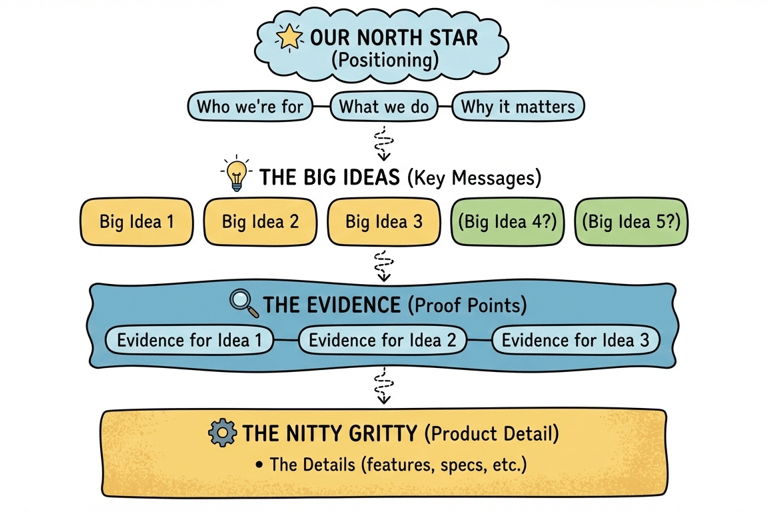
What I'm talking about is different. I mean a live, working document that tells everyone on the team (and anyone you're working with) what you're actually trying to say, in order of priority.
At the top: Your positioning. Who you're for, what you do, why it matters.
Below that: Three to five key messages. The specific claims you want customers to walk away believing.
Below that: Proof points. The evidence that supports each claim.
Below that: Product detail. The specifics that change as the product evolves.
The rule is simple. Everything you create has to hold up against the levels above it. You can add product detail at the bottom without touching anything higher. But if a product change genuinely shifts one of your key messages or your positioning, that's a conscious decision, not a quick edit.
This stops the slow drift that kills positioning over time. Without it, everyone on the team makes individually reasonable decisions that collectively pull your messaging in four different directions. Six months later, you wonder why nothing feels coherent.
Design your content so parts of it can be swapped out
Think of your content like a burger. Stay with me.
The bun (your positioning, your brand story, the problem you're solving) stays the same. The filling (specific features, use cases, current product capabilities) gets updated as the product evolves.
The mistake a lot of teams make is weaving product specifics all the way through everything they write. It means every product update potentially touches every piece of content. Instead, try to keep product-specific claims in clearly defined, contained sections that can be refreshed without rebuilding the whole thing.
This also changes how you think about your content mix. Not everything you produce needs to be tied to the current state of the product. Educational content, customer problem content, and thought leadership tend to age really well. They're not hostage to what version of the product you're on.
A lean team spending 80% of its content effort on product updates is going to feel the treadmill most acutely. If you build a base of durable content, and you suddenly have much more capacity to handle the product-specific stuff without losing your mind.
Get into the product roadmap before things ship - not after
I know. This sounds obvious. And yet, if I asked most startup marketers how they find out about product changes, they'd tell me one of three things: someone mentions it in a Slack channel, they read the release notes after the fact, or they find out because a customer asks about something that's already live.
None of these are good. All of them are extremely common.
What you need is a regular conversation with the product team that happens before things ship. It doesn't need to be long. A fortnightly thirty-minute check-in or even a weekly 5 minute standup, where product walks you through what's coming in the next few weeks is genuinely transformative. Not because it gives you control over what ships, but because it gives you enough time to actually prepare – you aren’t blindsided!
You can update the website before customers notice it's wrong. You can brief the sales team before they walk into a demo. You can write the email before someone in your database sees the new feature and wonders why nobody told them.
The tricky part is keeping this meeting alive. In fast-moving companies, it's the first thing to get cancelled when something urgent comes up. Make the case that the cost of cancelling is higher than whatever pulled the calendar invite. Frame it in terms of sales readiness and customer experience, not marketing workload. It’s much harder to argue with that .
Triage everything; not every update is equally urgent
This is the one lean teams struggle with most, because it feels like admitting defeat.
When you're small and the product is moving fast, you cannot update every single piece of marketing collateral every time something changes. If you try, you'll spend all your time in maintenance mode and never build anything that moves you forward. And you'll be exhausted.
The answer is to make your triage explicit instead of letting it happen accidentally.
When a product change lands, ask three questions. How material is this change? How much of our customer-facing marketing does it actually affect? And what's the real cost of leaving things as-is for a bit?
Some things need to be fixed immediately. If pricing has changed, if a feature you've been actively selling no longer exists, if your homepage makes a claim that's now factually wrong, you have to fix it now.
Some things can wait for your next content review cycle. Most feature additions fall here. They add to what you offer, but they don't break what you've already said.
Some things genuinely don't matter that much. Minor UI changes, internal restructures, feature renames that don't affect how the product works. These can sit on the list.
Making this distinction deliberately (as a team, out loud) stops the spiral where everything feels equally urgent and you end up doing reactive busywork instead of the work that actually matters.
A quick tip to help manage expectations: Keep key stakeholders across theses things that you have and have not updated so there are no surprises.
Keep a running record of what you've promised publicly
This one gets missed because it's quiet. But it causes real problems.
If you've been running marketing for a few months in a fast-moving company, you've made a lot of promises. Ads, email sequences, landing pages, one-pagers. There are implicit and explicit claims out there in the world about what your product does and who it's for.
When the product changes significantly, some of those claims may no longer be accurate. And nobody is tracking this. Marketing knows what they said six months ago in theory, but in practice it's scattered across a dozen channels and nobody's pulling it together.
Keep a simple, running document of your core marketing claims. Your main ad messages. Your website's primary value propositions. The key promises in your email sequences. When the product shifts, check the list. You don't need to update everything at once. You just need to know where the gaps are so you can make conscious decisions, rather than discovering the mismatch when a customer calls it out.
It's also incredibly useful when you onboard a new team member or bring in an agency. Instead of saying 'just have a look at the website,' you have something that represents the actual current state of your positioning, separate from whatever the website says right now.
The treadmill isn't going away. But it doesn't have to run you.
If you heed this advice perfectly, unfortunately still, none of this makes the treadmill stop. If you're inside a fast-moving company, your product will always be a few steps ahead of your marketing. That's just the nature of the thing.
But there's a big difference between a team that's permanently reactive (firefighting every release, always feeling behind, never quite getting ahead of it) and a team that has enough structure to absorb change without falling apart.
The marketers I've seen handle this well aren't the ones working the hardest. They're the ones who have thought clearly about what needs to be stable, what's allowed to move, and how to make decisions quickly when the product shifts again.
The treadmill is yours. Run it at your pace.
Contact Us
© 2025. All rights reserved.